
The five questions we hear most often and how we help answer them
Over the past several months, we’ve spent a lot of time at conferences and client meetings talking with Consumer Insights, Consumer Science, Sensory and R&D leaders about the decisions sitting behind their research briefs and there are some common questions.
How do we optimize our product for launch? Is the new formulation really better? Can we defend product distinction? Is the branded experience helping or hurting? Are our ingredients and claims building confidence or creating doubt?
So, we took a look across the work we are doing for clients and identified what clients ask FlavorWiki to do most often? And the same five questions come up again and again, with a clear pattern: most of them come back to competition.
Teams want to know where they stand, why they are winning or losing, and what they should do next.
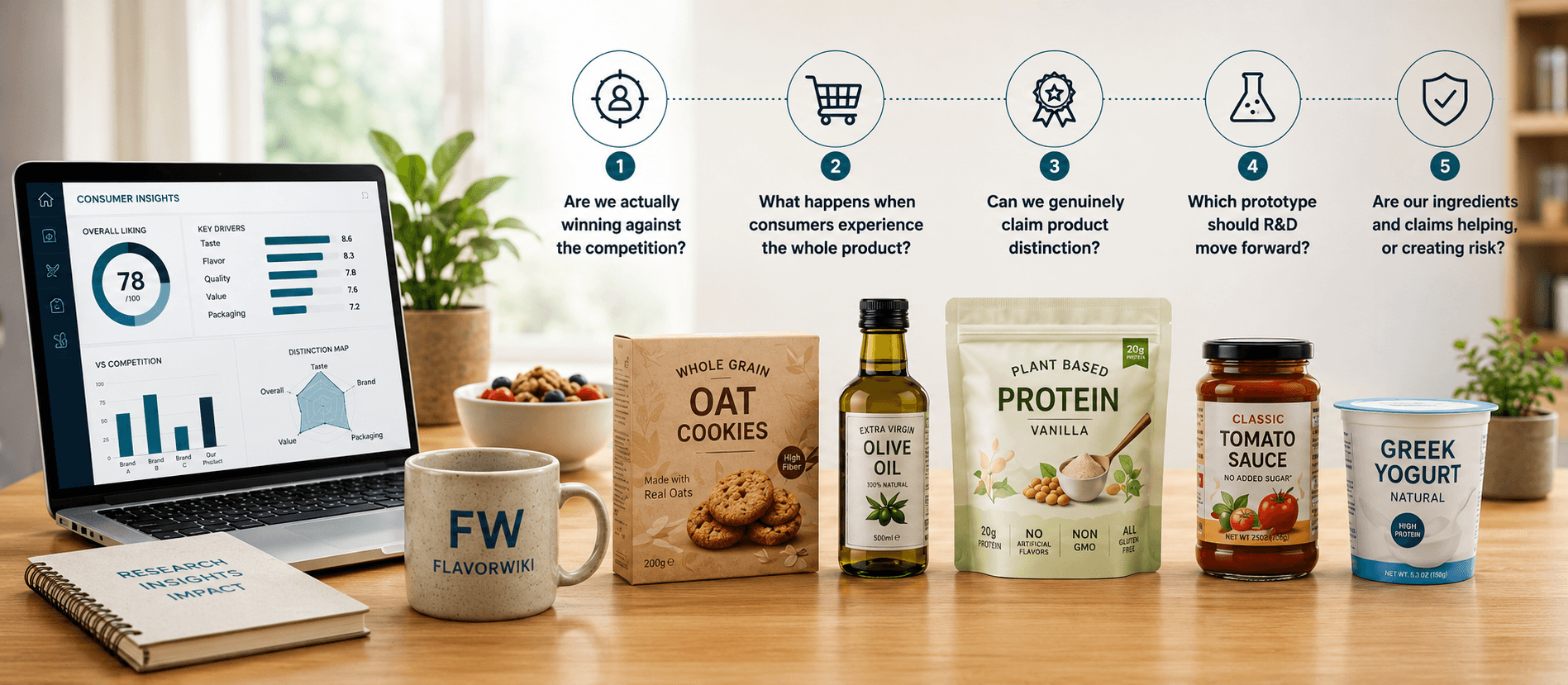
Here are the five questions we hear most frequently and what the strongest teams do differently.
1. Are we actually winning against the competition?
This is probably the question we hear more than any other.
Most teams already have a view, often several views. Sales has one view, Marketing another, and R&D may have a third. The problem is that those views often come from different data, different markets or different moments in time.
You can test a product on its own and get a strong score. But strong compared with what? An 8 out of 10 can be a win, a tie or a warning depending on the category and the products consumers can actually choose.
That is why competitive benchmarking needs to do more than create a ranking. It should answer three things:
· Who wins?
· Why?
· What can the team do about it?
Typically, we combine overall liking with just-about-right diagnostics, sensory profiling and drivers-of-liking analysis in realistic usage conditions. Depending on the question, consumers may shop the product themselves or receive it at home. The point is to understand the product where it is actually used, not simply where it is easiest to test.
Real research we did:
We recently ran this exact exercise for a breakfast brand: 2,700 US consumers bought and tested eighteen products at home, involving national brands, challengers and private label. After ranking them, we found that bland, artificial and bitter notes destroyed liking across every segment, which told R&D precisely where the brand could take share.
For Insights, that creates a defensible recommendation. For R&D, it turns preference into formulation direction. For leadership, it makes the launch, restage or investment decision easier to call.
2. What happens when consumers experience the whole product?
Blind testing is important. But nobody shops blind.
Consumers see the brand, the pack, the price, the shelf and the claims. They open, prepare, taste and use the product as part of a real routine. Those are not distractions from the product experience. They are part of it.
A product can win blind and lose at the shelf. It can also look average in a controlled test and become much more compelling when packaging, occasion and convenience are present.
For many teams, the more useful question is not simply, “How does it taste?” It is, “Where does the experience build preference—and where does it lose it?”
A shopping home use test follows that full journey. Consumers shop for the product, evaluate it in-store, take it home and use it naturally. We can then connect sensory performance with packaging functionality, satisfaction, value and repurchase intent.
Real research we did:
When we modelled value-for-money drivers in a home use test for a condiments brand across two European markets, taste attributes shared the podium with moments no blind test can see: how easily consumers got the product out of the pack, opened it, and found it on shelf; and the answers shifted by pack format. The product experience didn't end at flavor; neither did the levers for preference.
Oftentimes the value is not in collecting more touchpoints for the sake of it. It is in showing which moments and attributes actually move preference and repeat behavior.
3. Can we genuinely claim product distinction or is parity enough?
Product distinction is one of those words that means something different depending on who is in the room. Marketing hears a claim. R&D hears a performance target. Leadership hears a KPI.
Before the study starts, the team needs to align on what the business objective has to prove.
Sometimes clear distinction is the objective. In other cases, parity on the core product experience may be the smarter outcome because the brand wins through price, packaging, availability or positioning. “Better” is only useful when it is defined against the real commercial strategy.
The bigger mistake could be treating it as a one-off question.
A single study gives you a snapshot. A structured competitive program gives you a baseline that can be repeated across waves, markets and portfolios. Using a consistent approach, teams can see whether their position is improving, eroding or changing by geography.
Real research outcome:
In one wave of a competitive program for a global snacks player, 8,100 consumers evaluated 27 products across six flavor segments. Products were determined and a call was made at a defined confidence level, separately for loyalists and the broader category. That baseline now repeats wave after wave, so the business debates decisions, not data.
4. Which prototype should R&D move forward?
Cost reduction, nutrition improvement, supply changes and regulatory requirements are mounting pressures on a brand and all valid reasons to make a change in a product. But consumers do not care why the formula changed, if the experience gets worse.
A prototype test therefore needs to protect what is already working while showing where the new formula can improve. “Prototype B won” is not enough. The team needs to know:
· Does it improve or at least protect the current product?
· Can it hold its ground against a relevant competitor?
· Which sensory attributes are driving the result?
The strongest design usually includes the current product as a control and a key competitor as a category anchor. Blind monadic or sequential monadic testing can isolate the formula, while FlavorWiki’s patented Paired-Question sensory profiling and drivers-of-liking analysis delivers what ranking-only benchmarks cannot.
The best prototype is not always simply the one with the highest mean liking score. It is the one that delivers the business objective without giving up the attributes that make the product worth choosing.
5. Are our ingredients and claims helping, or creating risk?
An ingredient can signal health, naturalness, functionality, unfamiliarity or risk. A claim can create relevance, or imply a trade-off the consumer does not want to make.
“Reduced sugar” is a simple example. One consumer may hear “healthier.” Others may hear “less enjoyable.” A familiar ingredient can reassure one group and create scrutiny for another.
When these reactions are tested too late, teams discover the problem after the formulation is locked, the packaging is designed or the claim has already entered the approval process.
Claims and ingredient risk testing gives teams an earlier read. Implicit and explicit digital research can measure acceptance, rejection and emotional response, including the difference between label-aware and non-label-aware reactions.
The useful output is not simply a list of the highest-scoring claims. It is a clear view of which ingredient and claim combinations are believable, motivating and consistent with the actual product experience.
Consumers start evaluating a product before the first bite or sip so ensure your claims align with
What these five questions tell us about better product research
1. Start with the decision, not the acronym
2. Match the context to the decision
3. Move past the score
4. Design the first study with the next one in mind
Bring us the question that keeps you stuck
Some of our most valuable client programs started with a narrow brief: benchmark this product, validate this restage or screen these prototypes.
The value grew when the first study became wave one of a repeatable program.
That is how product research stops being a sequence of disconnected reports and starts becoming a learning system. A baseline becomes a tracker. A local decision becomes a global comparison. Each study makes the next decision faster and better informed.
The goal is not more data. It is a clearer decision, shared confidence across functions and learning that becomes more valuable over time.
Move to where a test starts to become an asset. That first competitive study becomes the baseline. The baseline becomes a tracker. The tracker becomes a shared language for how the business manages product performance.
_Image-1.png&w=3840&q=75)