
_Image-1.png&w=3840&q=75)
What Leading CPG Brands Are Learning About the Future of Product Innovation:
Over the past several months, I’ve had the opportunity to sit in the audience for a series of presentations from some of the world’s leading consumer insights, sensory, R&D and innovation teams and one thing became increasingly clear:
The consumer research industry is undergoing a structural shift. A real shift in how brands understand products, consumers and what it takes to deliver the growth their companies demand.
What emerged across these presentations was a new operating model for innovation, one built around what I would call Consumer Experience Intelligence.
Winning products are no longer created by optimizing isolated product attributes alone. They are created by understanding the entire consumer experience surrounding the product. That shift has major implications for every team involved in innovation; as it happens continuously, contextually and at scale.
Because increasingly, product success is being shaped by factors traditional research systems were never fully designed to measure together.
The Industry Is Moving Beyond Product Testing
For decades, most product research was built around a relatively linear process:
- Develop a concept
- Optimize the formula
- Validate liking
- Launch
- Measure performance
That system created enormous value for the industry. But listening across these sessions, it became clear that many organizations are recognizing a growing limitation:
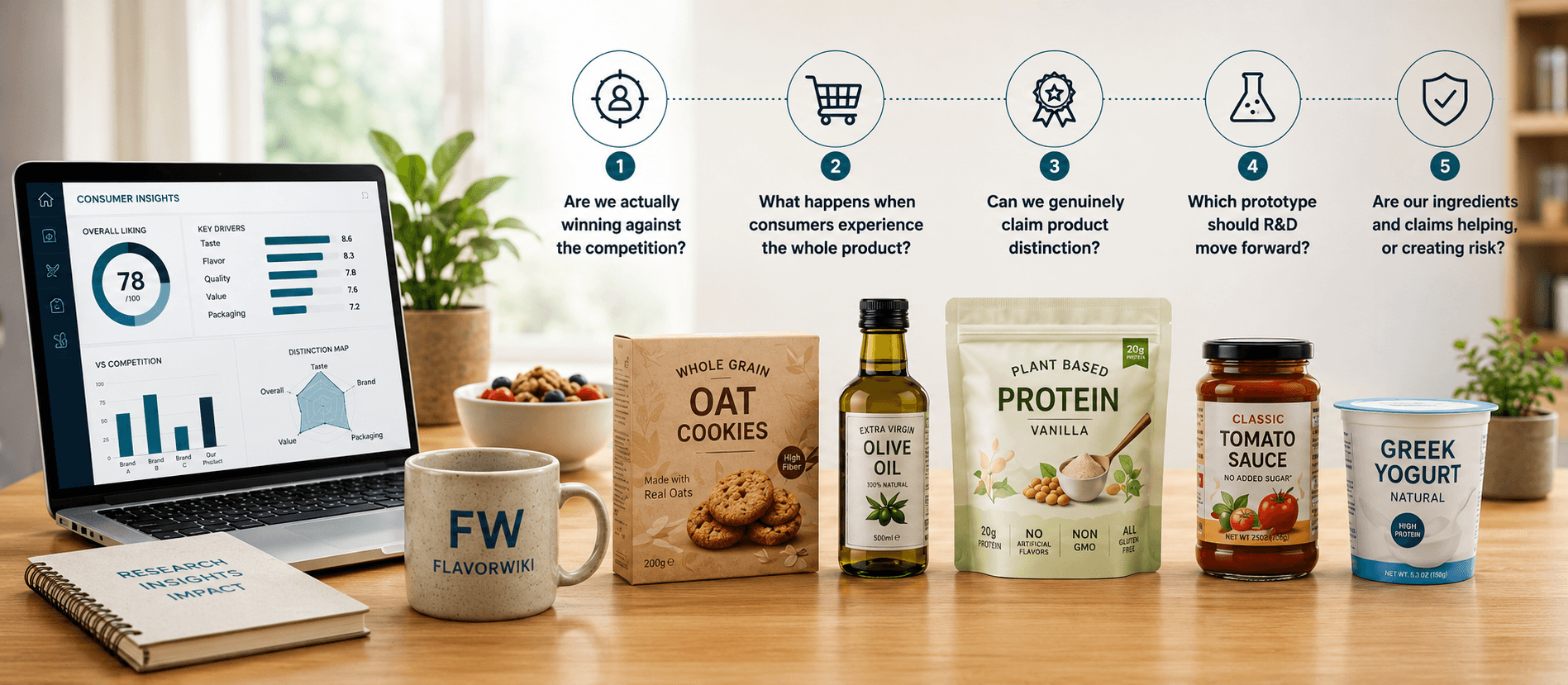
Consumers do not experience products in isolated testing environments. They experience them as part of a much larger system, including:
- Overall brand expectations
- Shelf context, pricing and packaging cues
- Consumer perceptions regarding wellness, emotional needs and social usage
- Convenience and competitive alternatives
Highlighted from the learning that true product superiority depends on performance within brand cues, packaging, pricing, and competition. Which is a clear statement that outlines the heart of where the industry is going.
The question is no longer simply: “Does the consumer like the product?”
The question is increasingly: “Does the entire experience create preference, differentiation, and repeat behavior in real life?”
Theme 1: Consumer Experience Is Multi-Dimensional
One of the clearest learnings was that consumers evaluate products through far more dimensions than traditional hedonic metrics alone.
Much of the research explored how consumers assess products not only through flavor and sensory enjoyment, but also through:
- Emotional well-being
- Physical well-being
- Social relevance
- Lifestyle alignment
In one case the team found that well-being measures were not strongly correlated with standard liking metrics. Which is a finding that matters significantly for teams across R&D and consumer insights.
It suggests that many traditional product testing systems may only be measuring part of what ultimately drives consumer choice.
A product may score well sensorially but still fail to:
- Reinforce identity
- Support wellness expectations
- Create emotional reassurance
- Justify indulgence
- Align with how consumers want to feel
Across categories like snacks, beverages, wellness products, and functional foods, consumers are increasingly evaluating products holistically.
The implication is profound:
Future product optimization will require understanding not just what consumers taste, but what consumers experience.
Theme 2: Real-World Context Changes Everything
Another theme repeated consistently throughout the presentations was the importance of measuring products in real consumption environments.
Historically, much of consumer research has focused on removing “noise” from testing:
- Blinded products
- Controlled environments
- Standardized serving conditions
Those methodologies remain critically important, especially for sensory diagnostics and formulation work.
But multiple presenters emphasized that real-world context often explains the gap between strong testing performance and real market outcomes.
Some products achieved strong liking scores, yet underperformed on purchase intent and repeat expectations because the surrounding experience altered consumer perception.
Another session argued that CLTs and in-home testing should not be viewed as competing methodologies, but complementary systems designed to answer different business questions.
Which is a distinction becoming increasingly important inside modern CPG organizations.
In-context testing answers:
- Does the proposition work in real life?
- Does the product justify its price?
- Does packaging communicate effectively?
- Does the experience support repeat behavior?
- Does the product outperform competitors in actual usage occasions?
That broader understanding is becoming essential as innovation cycles accelerate and the cost of failed launches increases.
Theme 3: Product Experience Is Becoming a Cross-Functional Discipline
One of the most interesting observations across these presentations was how innovation teams are increasingly converging around a shared objective: understanding the complete product experience.
Historically, organizations often approached product development in silos:
- Sensory focused on formulation
- Consumer insights focused on preference
- Marketing focused on positioning
- Commercial teams focused on distribution and pricing
But consumer behavior does not operate in silos. And increasingly, neither can innovation systems.
The presentations repeatedly demonstrated that the strongest product decisions emerge when organizations connect: sensory diagnostics, behavioral understanding and emotional response, with the 4 P’s.
This is one of the most important implications of Consumer Experience Intelligence, and creates a shared language across functions.
Instead of debating isolated metrics, organizations can align around a more complete understanding of:
- What consumers expect
- What they experience
- What creates differentiation
- What drives repeat choice
That shift may ultimately become one of the biggest organizational advantages for modern innovation teams.
Theme 4: Great Research Is No Longer About Individual Studies, It’s About Building Continuous Learning Systems
One of the strongest themes across all of the presentations was a redefinition of what “great research” actually looks like inside modern CPG organizations.
Historically, research was often conducted as a series of isolated events, with each study answered a question in a moment of time.
But increasingly, leading organizations are recognizing that the real competitive advantage does not come from individual projects alone. It comes from building connected learning systems that accumulate intelligence continuously over time.
It sounds simple, but the implication is significant. The goal of research is no longer to just generate data but to drive institutional learning capable of;
- Benchmarking products globally
- Tracking changing consumer expectations
- Identifying emerging experience gaps earlier
- Connecting sensory, behavioral and contextual learning
At the same time, another important misconception is beginning to disappear across the industry: the belief that speed and rigor are opposing forces.
Historically, organizations often assumed faster research meant sacrificing quality, depth, or confidence. But the strongest presentations challenged that assumption directly, while improving decision confidence.
Successful organizations work across teams to ensure each stage is built upon the previous one. Each learning strengthened the next decision to form connected systems of continuous learning.
So What Does This Mean for Teams Across Consumer Science, Insights, and R&D?
Innovation speed and data discipline are not opposites. They’re competitive advantage. Which is a mindset we believe will ultimately define the future of Consumer Experience Intelligence.
At FlavorWiki and GPI, these conversations strongly reinforce the direction we believe the industry is moving.
The brands that can continuously understand, measure, and optimize that experience across; moments, occasions, markets, and emotional contexts, will ultimately build stronger products and smarter innovation systems.